
Searching Elkhart County Civil Dockets
Your first stop is Indiana MyCase, the public search for non-confidential Odyssey cases. The Case tab takes one identifier at a time. It accepts a case number, citation number, or cross-reference number. Prefer the Name tab for people. It pairs a last name with a first name, middle name, or date of birth, and business names work too. Court, case status, and filing-date filters tame a common name.
Check the caption, case-type code, court, and status on the results page before trusting an event. MyCase caps broad result sets and may show a captcha. When nothing comes back, drop the optional filters. Try alternate spellings and sounds-like variants. Then call the Clerk. Keep in mind that protection-order cases live in a separate state search. They never appear in ordinary MyCase results.
- Choose Case for a known number or Name for a party.
- Enter the narrowest reliable terms.
- Select the likely Elkhart County court node.
- Confirm the caption and civil case-type code.
- Read the CCS in date order and ask the Clerk for an official copy.
Elkhart Civil Court Assignment Map
Civil cases in Elkhart County are spread across courts, not gathered in one place. The Elkhart Local Rules draw the map. Circuit Court takes a share of plenary and tort matters. Tax-sale and tax-petition cases and certain expungement matters go there too. Superior Court 2 handles commercial disputes and mortgage foreclosures. Estates and trusts, judicial review, mental-health cases, and other assigned work land there as well. Collections, small claims, and evictions go to Superior Court 5. That court takes another share of plenary and tort cases.
This map is why the case number matters so much. A search limited to Circuit Court can miss a valid Elkhart County civil docket. The case may sit in a Superior Court instead. Assignment can also shift through transfer, recusal, or special-judge rules. For where a case truly sits, trust the court field on the newest CCS entry.
| Local court | Selected civil assignment |
|---|---|
| Circuit Court | Shares of plenary and tort, tax matters, and specified expungements |
| Superior Court 2 | Commercial, foreclosure, estate, judicial review, and assigned civil cases |
| Superior Court 5 | Collections, small claims, evictions, and shares of plenary and tort |
| Superior Court 6 | Unified Family Court and juvenile work |
Inside an Elkhart County Civil Docket
Under Indiana Trial Rule 77, the CCS lists judicial events in the order they happened. A docket is not the full case file, though. It shows that a complaint, answer, motion, proof of service, order, hearing, judgment, or payment event occurred, even when the linked document is unavailable online. Watch the dates, too. An entry date can differ from the date of the filing or event it describes.
| Case number | Uniform Indiana number with county, court, date, type, and sequence |
|---|---|
| Parties | Plaintiff, defendant, petitioner, respondent, or other public roles |
| Filings | Pleadings, answers, notices, returns of service, and public exhibits |
| Motions and orders | Requests, rulings, scheduling orders, and judgment entries |
| Settings | Conference, hearing, trial, and compliance dates |
| Financial record | Costs, payments, credits, and balances that may lag the Clerk ledger |
A civil code like 20D05-2602-SC-000321 is just a format example, not a real case. SC stands for small claims. Other Elkhart County types include PL for plenary civil and CT for tort/civil. CC means collections. EV means eviction. When a code is unclear, read the expanded CCS description instead of guessing.
Elkhart Superior 2 Commercial Court
Elkhart Superior Court 2 is one of Indiana's six Commercial Courts. Local Rule 106.2 sends eligible commercial matters there. It also takes all mortgage foreclosures, estates and trusts, judicial review, non-family protection orders, miscellaneous civil matters, Red Flag proceedings, and shares of plenary, tort, and mental-health cases. The label is a real local specialty. But it does not mean every dispute involving a business qualifies.
On MyCase, search by civil case number or exact party names. Then confirm Superior Court 2 as the assigned court on the results. Read the CCS for any order accepting, declining, or transferring a matter. A calendar entry only shows a setting, never the outcome. A linked order adds context, but a certified order must come from the Clerk.
Note: The assigned court and the CCS entries control placement. A party name or business subject alone does not establish Commercial Court placement.
Civil Case Types on the Docket
Elkhart County civil dockets follow distinct paths. Each has its own court and level of public access. The local rules sort cases into categories wider than everyday speech. Plenary simply means a general civil action that fits no more specific case type. Tort usually involves an alleged civil wrong. Collections and eviction cases land in Superior Court 5. Estates and trusts route to Superior Court 2.
- Plenary, tort, property, mortgage, and contract-related matters
- Collections, eviction, and small-claims cases
- Estates, trusts, judicial review, and eligible commercial matters
- Dissolution, paternity, guardianship, adoption, and custody matters
- Non-criminal protection orders and other assigned proceedings
The small-claims ceiling is $10,000 or less. Small claims moves through a simpler process, yet public access still follows the Indiana court-record rules. A claim amount on MyCase is no substitute for the official file.
Elkhart Small Claims in Superior 5
Superior Court 5 carries Elkhart County collections, small claims, and evictions. Read a small-claims docket from start to finish. Filing, service, appearance, default or hearing, judgment, and the payment events that follow. A judgment line is not a current payoff. MyCase financial entries can lag. Ask the Clerk for the ledger or a certified judgment whenever an official amount matters.
Continuance rules deserve a close look. Local Rule 508 generally allows one small-claims continuance as of right. But a request made within seven days of the trial needs court approval. That rule explains why you might see a request entry. It may carry no proof the setting moved. Check the later order and confirm the date with the court.
Setting check: A motion to continue does not change an Elkhart County civil hearing by itself. Look for the court's ruling and current setting.
Civil Docket Settings and Hearings
A civil docket in Elkhart County can hold many kinds of settings. Status conferences, motion hearings, pretrial conferences, bench trials, jury trials, and compliance dates all show up here. One scheduling order may bundle several hearings and deadlines together. After that, the CCS tracks what happens next. Resets, continuances, cancellations, and events that wrap up. Always read the newest entries first. An old date can sit in the history long after the setting moved. So the latest entry beats the earliest one.
To double-check a public setting, try the Indiana Trial Court Calendars. The public window reaches back seven days and forward four weeks. Coverage is partial, though. Search by county, court, and date, adding case-number or name text if you have it. If nothing comes back, call the assigned court or the Clerk. The same goes for a result that clashes with a notice you received. For the full calendar route, see the county court dates resource.
One caution about labels. "Hearing," "status," or "trial" only tells you what was scheduled, not what the court decided. The outcome lives in the later CCS entry or the signed order.
Elkhart Unified Family Court
Family cases in Elkhart County have their own home. Superior Court 6 runs the Unified Family Court. It covers dissolution, paternity, guardianship, adoption, custody, grandparent visitation, non-criminal protection orders, IV-D child support, name or gender-marker changes, juvenile delinquency, and CHINS. That is a separate assignment. The main civil dockets sit in Circuit Court and Superior Courts 2 and 5. The county directory also lists family magistrates and a family referee.
- DC
- Dissolution case type.
- JP
- Paternity case type, with access affected by rules and filing date.
- GU
- Guardianship proceeding.
- JC
- Child in need of services matter, generally subject to confidentiality limits.
- RS
- Child-related family case category.
A CCS entry can be public. Its attached filing can still be restricted. Juvenile records, confidential family material, and protected personal information may be withheld from view. If a document seems missing, do not assume it was never filed. Use party-access procedures or ask the Clerk when the law gives you authorization.
Civil Docket Access Rules
Access to court records in Indiana starts with a presumption of openness. Indiana Access Rule 4 makes records available unless Rule 5, another law, or a court order says otherwise. Rule 5 governs the exceptions. Those include confidential and sealed cases, certain mental-health and paternity material, investigative requests, and personal identifiers that must be redacted or left out entirely. Within a single Elkhart County civil case, a public version and a nonpublic version can exist side by side. Rule 5 is also the official source for the assigned civil docket page.
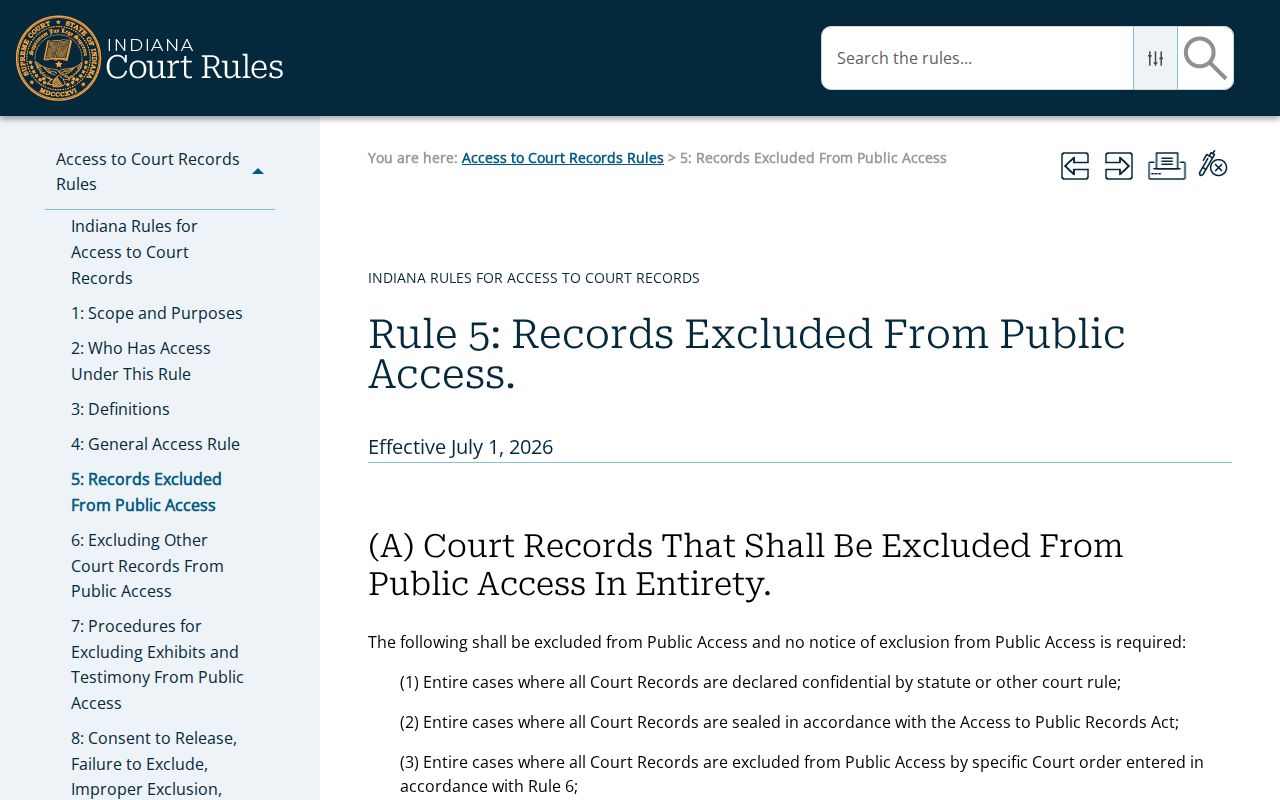
It reinforces why an event may be public while its attached document remains unavailable.
Public access: MyCase is a lookup layer. Rules 4 and 5, a sealing order, and any applicable statute determine access to the court record.
Requesting an Elkhart Civil Record
Start with MyCase. For a certified copy, a complete ledger, an older converted file, or any public document that is not posted online, go to the Elkhart County Clerk. The counter sits at 1905 Reliance Road in Goshen, and the office phone is 574-538-3000. Published hours run Monday 8:00 a.m. to 5:00 p.m. Tuesday through Friday hours are 8:00 a.m. to 4:00 p.m. You can request at the counter. Or call for instructions, or send a focused written request by mail.
Include the details that speed things up. Give the case number, the court, the document name, the date range, the format you want, and whether you need certification. Indiana's standard reference lists $1 per page for a letter or legal copy. Certification under seal adds $1. Still, ask the Clerk for a current quote and the accepted payment method. The court posts no Elkhart-specific copy form, no electronic-search fee, and no guaranteed turnaround.
Timing rules come from Indiana Code 5-14-3 and Public Access Counselor guidance. Acknowledgement is not production. Phone or in-person requests should be acknowledged within 24 hours. Mailed, emailed, or faxed requests get seven calendar days. Production itself is due within a reasonable time. A written denial must state its legal basis.